
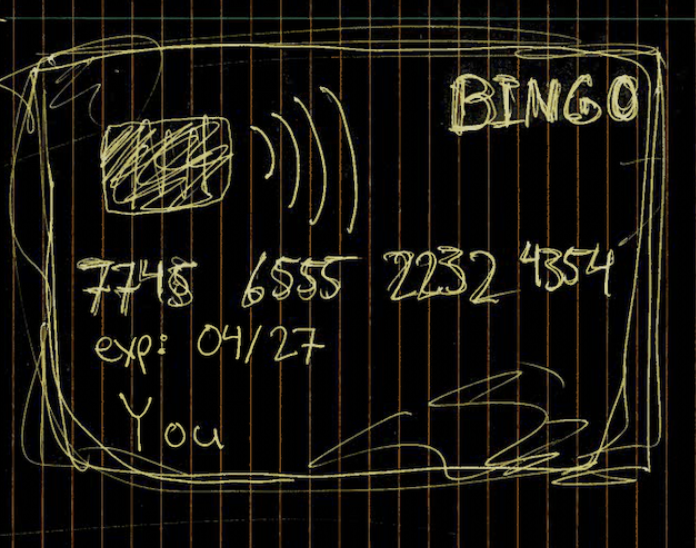
Bingo Bank: An interactive novel on data harms
Written by: Francis Léveillé (Ph.D. candidate, Preventing Data Harms in Canada/Aging in Data Lab, Concordia University)
An important part of the Data Harms in Canada: Investigating the Significance of Age Project consisted of a qualitative content analysis of Canadian news media articles discussing data harms. As I was sampling and then coding hundreds of these newspaper articles, I took a class on game design as research-creation with my supervisor Professor Mia Consalvo in the Department of Communication Studies at Concordia University. I was thus inspired to create Bingo Bank as a reflection of the work we had been doing on the Data Harms project.
The design process began after over 300 news articles referencing various forms of data harm had been hand-coded. At that point, initial analyses revealed that media coverage frequently instills fear by continuously highlighting threats while failing to provide clear descriptions of those risks or actionable steps to mitigate them. Furthermore, news coverage pays remarkably little attention to the emotional and economic consequences of data harms. Bingo Bank addresses this gap by reflecting on how individuals experience the fallout of data harms, specifically focusing on a case of identity theft caused by a data leak – a narrative directly informed by my own personal experience with identity theft. Ultimately, designing the game provided a creative avenue to “test” our empirical findings. Chapman and Sawchuk (2012) categorize this form of research-creation as “creation-as-research,” where the iterative process of game design functions as a theorizing exercise that deepens and expands critical analysis.
Chapman and Sawchuk (2012) emphasize that creation-as-research is distinct in its “interweaving of theory and practice” (20). Creative production opens up alternative modes of engaging with theory that are just as valuable as conventional analytical writing, often revealing theoretical insights that would otherwise remain unnoticed. Creative methods – including game design – naturally resist fixed formulations because they are inherently iterative. Designing a game grounded in empirical data and guided by a theoretical framework contributes directly to the act of theorizing by creatively bridging the two. As the game is iteratively developed and played, both key structural connections and extraneous details become clearly visible.
Through this iterative process, it became evident that I was trying to reflect on the human organizations operating behind complex technological systems. In the scenario depicted in Bingo Bank, harm does not originate from technology itself. While the initial data leak enables a form of data harm, the protagonist’s experience reveals that the core negative impacts stem from bureaucratic structures and human administrative systems. By peeling back the layers beyond the initial leak, which is what is most often discussed in news media, the game illustrates that systems managing technological innovations are fundamentally driven by human interactions and emotions. The materiality and agency of data (Lupton 2018) are thus experienced as affective responses to these rigid human structures. Bingo Bank is a story of individual responsibilization in facing inefficient bureaucracies that collect data without providing transparency and efficient safeguards against the malicious uses of that same data. Sociologists Marion Fourcade and Kieran Healy (2013) theorize credit instruments as exemplary neoliberal tools of responsibilization due to their power to score and rank individuals. In a similar vein, Bingo Bank exposes the market-based logic governing the aftermath of data harms, a framework in which individuals are blamed for failing to navigate systems designed to shift institutional burden onto the user. The design process shifted the focus from abstract technological threats to the tangible, bureaucratic, and emotional realities that individuals must navigate in the wake of a data breach.
You can play the Bingo Bank game by clicking the block below!
References
Chapman, Owen and Kim Sawchuk. 2012. “Research-Creation: Intervention, Analysis and ‘Family Resemblances.’” Canadian Journal of Communication 37(1): 5-26. doi:10.22230/cjc.2012v37n1a2489.
Fourcade, Marion, and Kieran Healy. 2013. “Classification Situations: Life-Chances in the Neoliberal Era.” Accounting, Organizations and Society 38(8): 559-572. doi: 10.1016/j.aos.2013.11.002
Lupton, Deborah. 2018. « How Do Data Come to Matter? Living and Becoming with Personal Data ». Big Data & Society 5(2): 1-11. doi:10.1177/2053951718786314.