
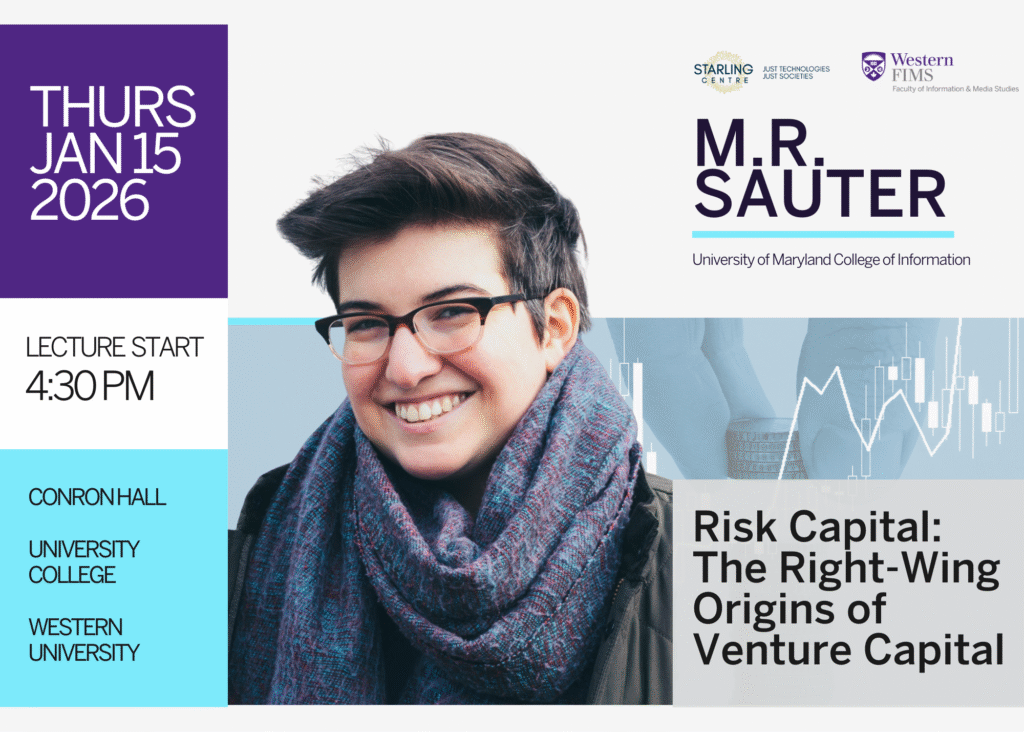
Risk Capital: The Right Wing Origins of Venture Capital
Along with the FIMS Rogers Chair (as part of the Rogers Chair “New Fascism” theme from 2025-2027), we are pleased to announce our first speaker of 2026: M.R. Sauter, who will present their talk on the right wing origins of venture capital.
Details at a Glance:
Date: Thursday 15 January 2026
Time: 4:30pm – 6:00pm
Location: Conron Hall University College Western University
Please register here:
https://uwo.eu.qualtrics.com/jfe/form/SV_cUSliPCpHnzBa06
In this talk, M.R. Sauter argues that the U.S. (and thus North American) innovation economy was constructed through financial law rather than technology policy. Focusing on the Employee Retirement Income Security Act (ERISA) and the regulatory construction of venture capital as patriotic “risk capital,” the talk examines how neoliberal reforms redefined prudence, risk, and fiduciary duty in ways that routed collective retirement savings into speculative finance while insulating financial elites from accountability. These changes normalized a political economy in which professional risk-taking was framed as a patriotic necessity, even as its costs were systematically displaced onto workers and the public. The talk situates this transformation within a broader trajectory of democratic erosion, showing how deregulation, politically mobilized risk narratives, and neoliberal financialization have proven structurally compatible with authoritarian and far-right projects that demand sacrifice without consent or reciprocity.
Speaker Bio: M.R. Sauter is an Assistant Professor at the University of Maryland College of Information. They are the author of The Coming Swarm: DDoS Actions, Hacktivism, and Civil Disobedience on the Internet and the forthcoming Risk Capital: How High Finance Remade High Technology (University of Chicago Press). Their research examines technology, finance, and political power, and has been published widely in academic journals and public-facing outlets. Sauter has held research fellowships at the Berkman-Klein Center for Internet and Society and New America, and they frequently appear as an expert on technology, culture, and politics in national and international media.