
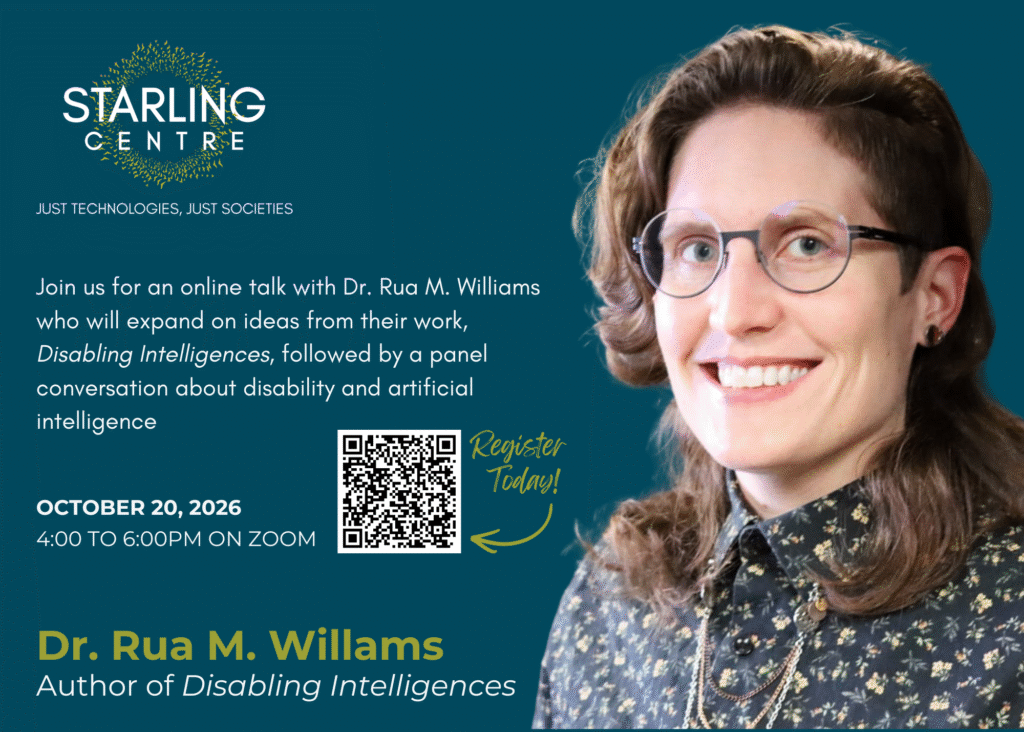
Public Talk: “Disabling Intelligences”
On Tuesday, October 20th from 4:00 to 6:00 PM, the Starling Centre at Western University will be hosting Rua M. Williams who will be giving a talk expanding on ideas from Disabling Intelligences. This talk will be followed by a panel of faculty and students from Western University sharing interdisciplinary perspectives on intersections, narratives, and matters of concern and possibility related to disability and AI. The panel will focus on both education and broader considerations. This talk will be hosted on Zoom and is open to all.
To join the talk, please register here
This event has been organized in collaboration with the Department of Anthropology at Western University and the Disability Studies Program at King’s University College.
Speaker
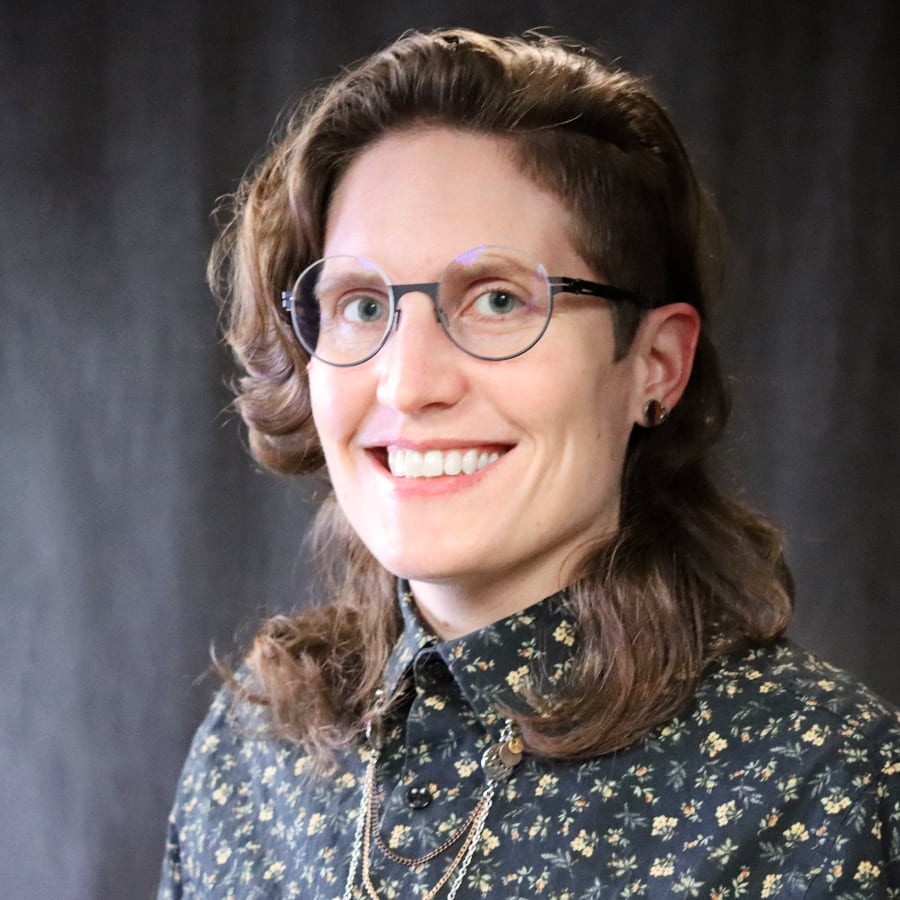
Rua M. Williams is an Assistant Professor in the User Experience Design Program within the School of Applied and Creative Computing at Purdue University and Principal Investigator of the CoLiberation Lab. Their work focuses on the intersection of disability justice, technology design, and computing research, exploring how disabled individuals imagine and construct their own sociotechnical worlds. By deploying feminist, antiracist, and critical disability studies frameworks, Dr. Williams investigates how technology policies and research practices interact to either disrupt or enable disabled people’s bodily autonomy and access to a meaningful public life. Dr. Williams is the author of Disabling Intelligences: Legacies of Eugenics and How We Are Wrong About AI. Through their research and advocacy, they continuously reshape how society designs, evaluates, and interacts with adaptive technological systems.
Alt Text: Rua Williams is a white queer presenting person smiling towards the camera in semi profile. They are wearing a floral shirt in black and gold and have round black glasses.
Panelists

Pamela Block is a Disability Anthropologist and Professor at Western University. Broadly her research interests include disability culture and social movements, and sociocultural perceptions of disability. She studies the intersection of gender, race, economic status, and sexuality in movements for disability liberation (justice and rights) and disability oppression (eugenics, sterilization, mass-incarceration and killing) in Brazil, the US, and Canada. She is also interested in the emergence of disability studies scholarship around the globe. She is both concerned by how generative AI has been trained to represent disabled people but also aware of some AI technologies are beneficial for some disabled people.
Alt text: smiling woman in a straw hat with a black band and a flowered shirt. The sun, sky, lake, and a rock cliff in the background.
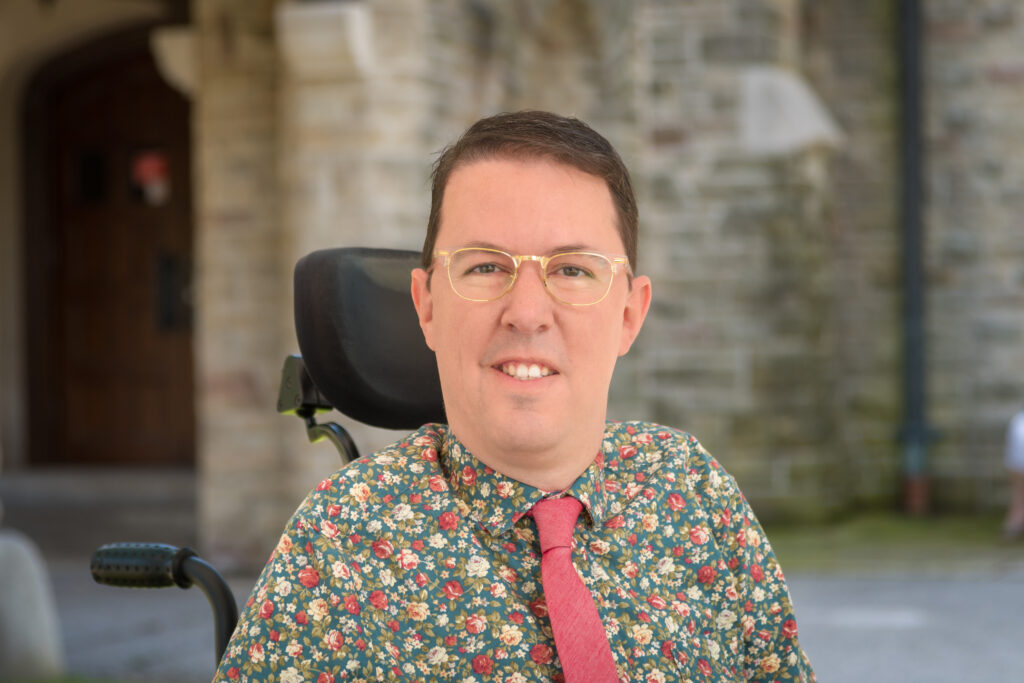
Jeff Preston, Ph.D., is an associate professor and chair of Disability Studies at King’s University College at Western University. Born with a rare neuro myopathy, Jeff is a long-time advocate and public speaker, giving talks across the country focused on the intersection of disability, subjectivity, biopower and culture. He is also a past member of the Accessibility Standards Advisory Committee for the Ministry of Community and Social Services, working on the Accessibility for Ontarians with Disabilities Act, past board chair of Defeat Duchenne Canada, and current board chair of the Palace Theatre Arts Commons. Jeff is also regularly sought in media, with appearances on national news programs like CTV’s The National and CBC Marketplace.
Alt text: Jeff, a youngish white man with short brown hair, sits in his black power chair wearing gold-rimmed glasses and a floral dress shirt with slim red tie.
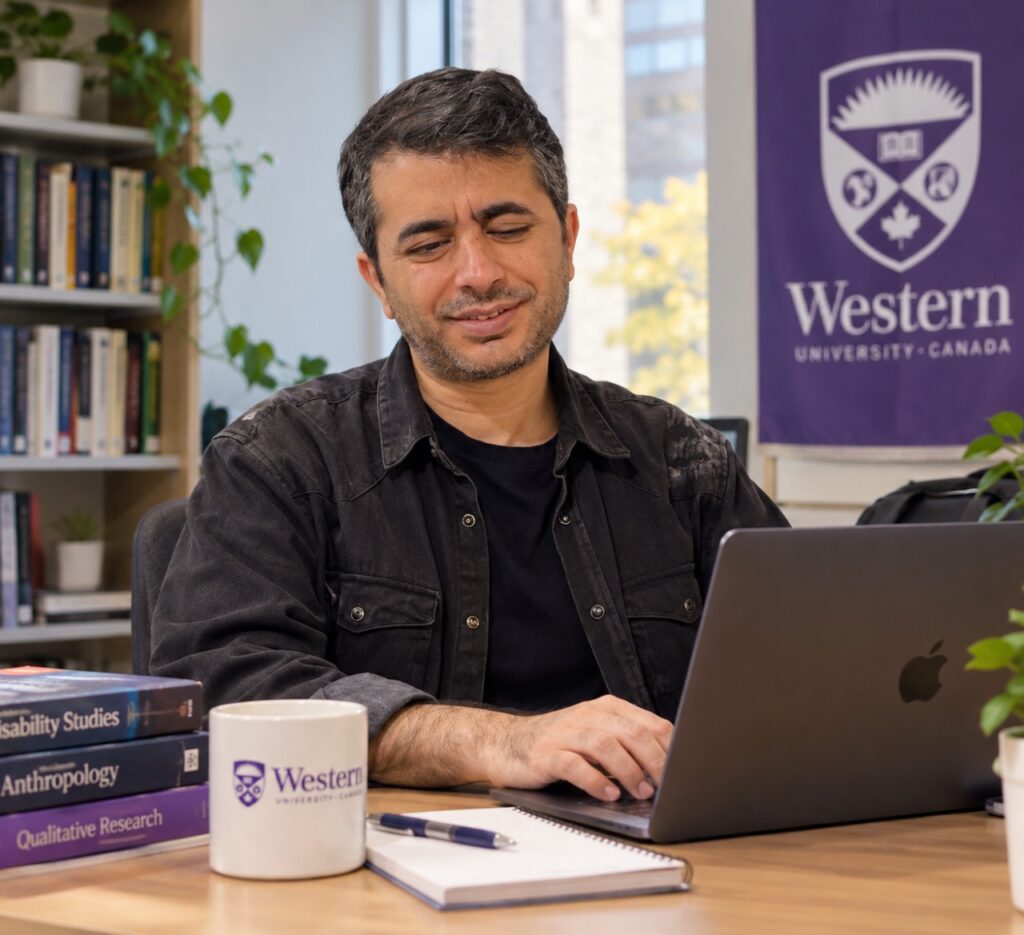
Abouzar Samiei is a PhD candidate in Sociocultural Anthropology at Western University. His research focuses on academic ableism and how disabled students navigate higher education in Iran and Canada. As a researcher in disability anthropology, he is interested in both AI’s potential to increase access and independence and its capacity to reproduce ableist assumptions and stereotypes about disabled people.
Alt text: Abouzar Samiei sitting at a desk and working on a laptop in a university office. He is wearing a black shirt and dark overshirt, with books, plants, and Western University items visible around him.
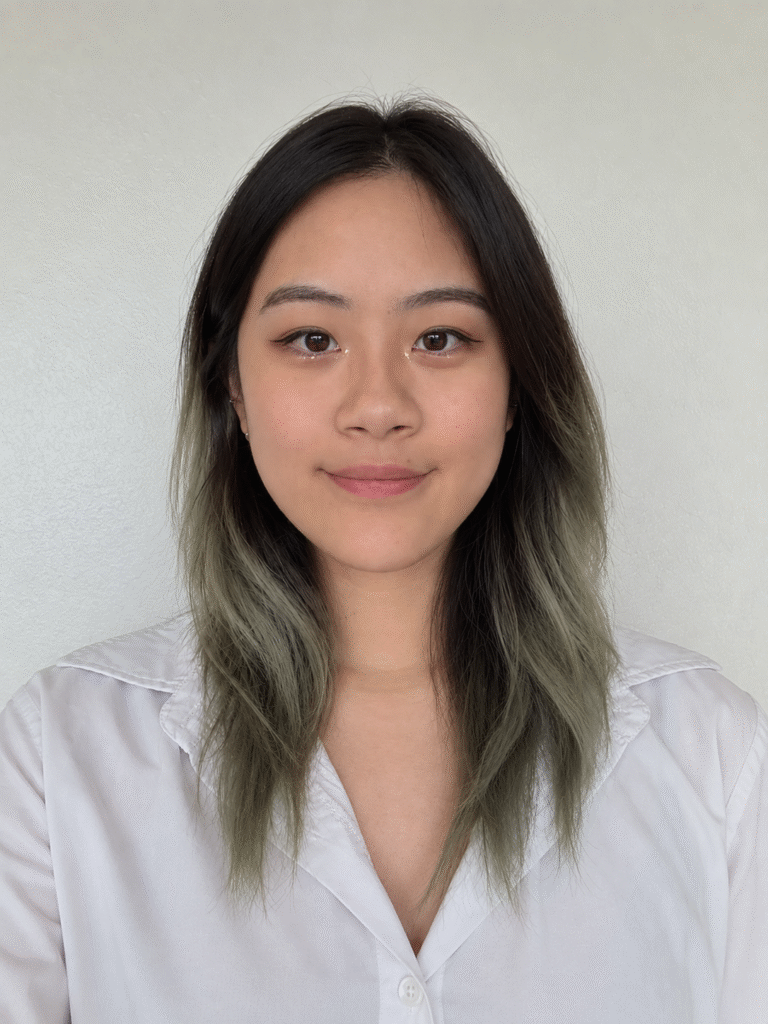
Kat Chen is a second-year Ph.D. Media Studies student at Western University, under the supervision of Professor Luke Stark. They received their B.A. in Communications and M.S. in Digital Social Media. Their research interests focus on Critical AI Studies, Neurodiversity, and Personhood Justice.
Alt text: A front-facing portrait of an east asian female presenting human with dark hair fading into muted green-gray ends, wearing a white collared shirt. They’re smiling softly at the camera against a plain light-colored background, with subtle makeup, winged eyeliner, and small earrings.
Facilitator

Dani Dilkes is an interdisciplinary scholar whose work sits at the intersection of feminist sociomaterialism, design and access justice, and critical pedagogy. She recently completed her doctoral studies at the Ontario Institute for Studies in Education at the University of Toronto, where her research explored the sociomaterial conditions of exclusion in postsecondary education. Through this research, she coordinated a multi-month global codesign project imagining more inclusive postsecondary environments, resulting in the development of Desire Path Pedagogy. She will be starting a postdoctoral fellowship in the Faculty of Information and Media Studies In early 2027 that will explore educational and social imaginaries related to AI in education.
Alt text: Dani, a white female with shoulder-length reddish brown hair, sits facing the camera with a slight smile. She is wearing large blue rimmed glasses, a black and white striped shirt, and a black blazer. The background is in black and white and shows a wall of windows with the sills covered in various succulents.