
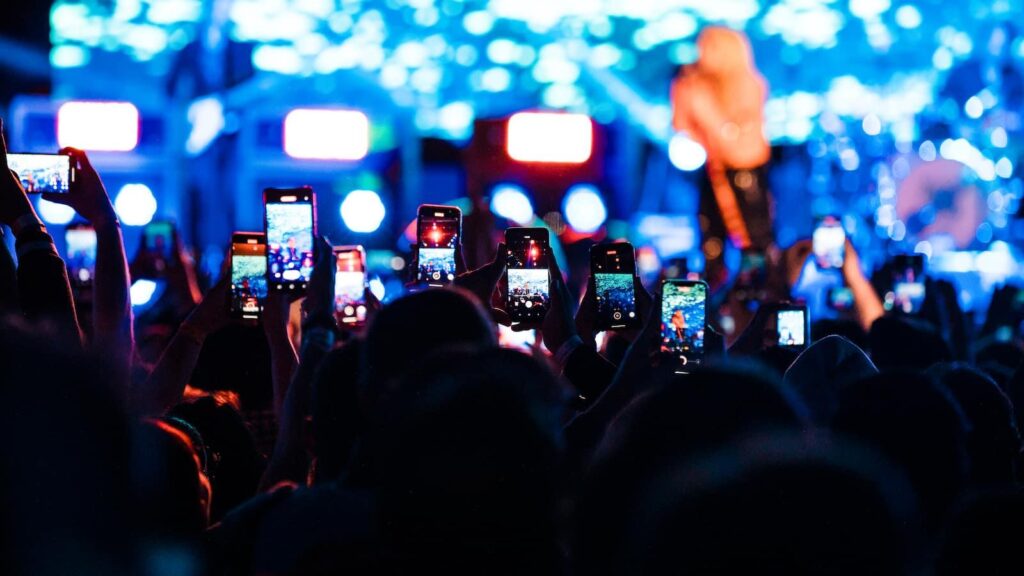
This is a No Phone Show: Why “Out of Sight” is not the Same as Addressed
By: Meghan Voll
This past February, I had the opportunity to see one of my favourite bands in Toronto, and it did not disappoint. In fact, I would put this show as one of the top three best concerts I’ve ever attended—if not the best—with artists like Il Volo or Billy Talent in the top three. What I did not anticipate was that this would turn into a “researchable moment” to observe the harmful effects that technologies can cause in everyday life. The wrongdoing in question that I refer to is a phenomenon I alluded to in an earlier blog post as potential and cultural harm. These harms are a phenomenon we’re looking at as part of the Investigating the Significance of Age: Data Harms in Canada Project at the Starling Centre. While I’d like to stress that our definition is developing, a cultural harm can refer to disruptions such as the homogenization of culture, caused by digital technologies (a shoutout to my colleague Francis Léveillé for coining this!). In this blog post, I’d like to speculate on what such an example of this harm might look like as it appeared to me when I attended this concert. A few days before the show, I received the following e-mail from the venue:
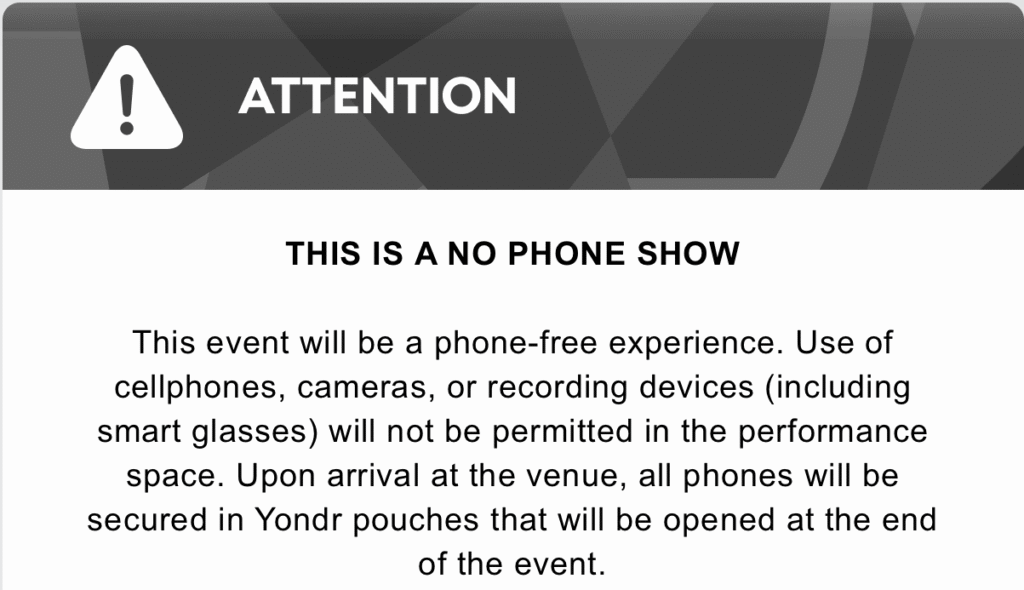
If you’re asking: what (in the world) is a Yondr? you’re not alone. Put very simply, it is a secure, lockable fabric bag used to create phone-free spaces in schools, concert venues, and workplaces. When I went to the concert, there was a Yondr station just after passing through security. They had a pouch open, asked for my phone, and “locked” it using a magnet. The pouch was then given back to me, and I could wear it around my neck or keep it in my bag for the duration of the show. I could use my phone in designated spaces, but it had to be locked up again by security once I left the space.
Here, it is important to note that the use of the Yondr pouch (or program) is becoming more normalized even though it is not immediately well known. In addition to being used throughout schools in the United States, it is also required by artists and comedians such as Bob Dylan, Jack White, and Chris Rock. This product is becoming more embedded in entertainment and its physical spaces.

The question remains as to why Yondr is becoming so normalized. From what I could research, there seem to be three competing points. First, artists want to control the distribution and consumption of the content they create. For comedians, this makes the most sense to me because their shows are contingent on the jokes they write. If one show ends up on YouTube for the world to see, it diminishes the value, surprise, and replicability of that content. From a monetary perspective, it is like giving away the show for free. Second, the choice to justify a Yondr pouch is values. Some artists believe that a certain relationship should exist between the artist and the concertgoers, which digital technologies ruin. Such experiences should foster “in the moment” thinking and allow for the full presence and attention of all attendees involved. Moreover, the Yondr pouch protects the value of the show in the same way that is valuable for comedians. For example, artists or actors who are involved with shows that draw upon sensitive themes or nudity may rely on programs, such as Yondr pouches, to prevent the sharing and recording of that sensitive imagery and content outside of the audience present.
This leads to the third reason I was able to find online for the pro-Yondr side. Many people believe the pouches will allow for a totally immersive experience, or one like “our parents used to tell us about in the 80s”. For this school of thought, Yondr pouches offer the chance to replicate or reclaim the value of cultural moments disrupted or eliminated by digital technologies. It is this line of thinking that signals to me a “red flag” that cultural wrongdoing (at the very least) is present.

Now, I don’t write all of this to critique the artists or people who see a need for this product, or indeed, argue that it is an increasingly normal part of entertainment in the “age of AI”. Yondr very well may be. It is the fact that it is becoming so normalized which reveals itself as the symptom—and not the cause—of cultural harm. The point I want to make in writing this post is that we must begin to consider whether the widespread implementation of digital technologies, such as AI, will change society for the better or for worse. The pro-Yondr side talks about a loss of connection between the artist and the crowd, and the irreplicability of the concert before technology. The experience was magical, indescribable, almost like something out of a movie. While such a change can also be attributed to the rose-tinted glasses of time, it is clear that something has come between, or disrupted, that experience and relationship. That ‘something’ is the ubiquity of digital technologies.
Consider that back “in the day”, restrictions over digital technologies were clearly in the responsibility of the individual, and control over such technologies was expected of the individual. For example, attendees of a concert, theatre, or play were expected to turn off their phones or keep them in their bags. Now, that same attendee exists in a digitally mediated world where it is expected that they broadcast their presence at the event and share it with those in their online networks. Indeed, the requirement to broadcast validates their presence at the event. The attendee may go to a concert for themselves, but there is a cultural expectation of mediation that eclipses that sacred moment between artist and admirer. The only solution that emerges is the forcible removal of the apparent source of that disruption: the physical device.
This proposed remedy is the basis of the Yondr pouch, which is why I believe it represents a critical disruption that digital technologies have created. However, I would like to suggest that the source of this cultural disruption is not singularly the devices themselves, but the addiction that platforms which operate on these devices create. The lynchpin of this argument is that the Yondr program also operates on the premise that the individual is no longer considered trustworthy to control or responsibly use their devices in these spaces. The attendee can no longer be trusted to honour the request of a venue or artist because of a cultural expectation of mediation that fosters addiction. Ironically, Yondr’ssolution to the problem of trust shifts such trust and responsibility onto more technology.
However, this solution only intensifies cultural wrongdoing because it deflects fault and prevents holding accountable actors who caused such wrongdoing in the first place. The value proposition of the Yondr program is the reliance on technologies (i.e. the pouches) to prevent the use of another technology (i.e. phones) because of how deeply the second technology has shifted shared norms of attention and presence. Here, Yondr misdiagnoses the actual cause of harm and the reason why individuals can no longer be considered trustworthy with their devices. The ideology of social validation or “pics or it didn’t happen” promoted by platforms such as Instagram or Facebook has irreversibly changed what it means to “be present” for the last two decades. It is not a novel claim that “presence” requires social proof, such as a selfie, at an event. I’m as guilty of this as they come.
This cultural change is not an inherently “phone” issue; it’s the result of years of cultural enclosure through data. Forced compliance does nothing to change this. The Yondr program enforces this premise, and it is why I do not believe it addresses the cultural wrongdoing and addiction caused by social media platforms. Instead, the program positions the device itself as the enemy rather than the addictive spaces that the platforms and attention economy create.
Regardless of your opinion of phones, these devices are no longer “just phones”. We use them for everything—from messaging friends to arranging transportation. If it is true that devices are the source of addiction, such addiction is also reinforced by real-world necessities. Consider that those who hold an anti-Yondr stance often express that they are uncomfortable with the forced lack of access the program enforces, particularly in the (unlikely) event of an emergency. I can’t say I blame them because not having access to my phone in any situation makes me uncomfortable. However, I would ask: Is this addiction or a reality of our current society? It is interesting that this claim also reinforces and misdiagnoses the cultural harm, and why individuals can no longer be considered trustworthy with their devices. Like the Yondr program, the anti-Yondr claim is also based on the premise that we cannot trust individuals and must transfer that trust to technologies. Venues are required to have security and contingency plans for emergencies for large-scale events such as concerts. So why is it we no longer trust them?
Such a transfer of trust is also why I would argue that any addiction to devices is indeed reinforced by real-world necessities. I spoke to several attendees who repeatedly described how they felt “naked” not being able to check their phones to tell the time or pay for merchandise. Interestingly, one attendee pointed out how the venue itself was not prepared to host a Yondr event because they no longer installed clocks on the walls. I also felt this sense of “nakedness” and lack of preparation. We were told this was a “no phone” show in advance, and despite this, we were still required to bring mobile versions of our tickets because the venue would not accept print-out copies. This contradiction reveals how physical spaces in the public sphere have been redesigned for mediation by digital technologies. We cannot easily overcome them without a very major and physical overhaul. The design of our public spaces is a very real obstacle which reinforces a negative cultural shift that causes addiction to digital technologies.

I am not suggesting that Yondr rework its program to become a tool that advocates and educates in the context of digital literacy (although the concept is interesting). The product clearly serves an immediate purpose for an immediate need. However, I (and others) felt that it was a waste of money on the artists’ part, particularly because their show was incredibly engaging and communal. Whether that was because the device was taken out of the equation, I cannot say. Instead, I will say that the belief that Yondr will replicate the “glory days” of concerts before technology, and reproduce the intimate relationship between artist and attendee, is a stretch. The core truth is that digital technologies have changed the culture of being social, and all that comes with it. I think the fact that many people (me included) are bothered by even a short-term loss of access to a device is proof of this. However, that proof also indicates that a big problem exists if we must also treat the problem like an addiction and rely on other technologies or products to manage our device usage. This is also why solving the problem by “locking it away” or “denying access” is not a long-term solution. We must look at the root causes of cultural wrongdoings, such as phone and social media addiction, and how they became permanent fixtures in daily life, if we are to address them. It is here that examples such as Yondr do us some good, because they enable us to see such root causes underneath. The next time you encounter something like the Yondr program in your daily life, see if you can spot the root causes of cultural harms, and how we might address them more long-term.